Sunday, December 11, 2011

Salvaging Stick Season


Over the last couple of weeks I have been consumed with the usual holiday rush of photography related chores, with very little having to do with actual shooting. Despite the disappointing and spotty foliage this year I still have a significant back-log of autumn images that are begging to be processed. I am working in the studio to get seasonally appropriate pictures out to my galleries in Peterborough, Keene and Brattleboro as well as responding to special orders that MUST be done before Christmas. Of course I am also slogging through prime calendar season, keeping the stores stocked and annoying everyone in town about buying their New England Reflections Calendar; “Don’t you care about your neighbors who struggle with chronic lung disease?”. Thank goodness that nature has provided us with November, perhaps the worst time of the year to find beauty in rural New England. With the leaves gone and winter snow still generally coming only in fleeting doses, it seems that there are few things worth venturing out into the cold. I know there will be those who revel in the challenge, but seriously wouldn’t you rather be shooting almost any other time of year? It seems an act of providence that, during this time of year, when I have so much to do inside, outside "stick season" is so uninteresting.


Despite the congestion in my November to-do list, and the generally dismal prospects I could never totally abstain from taking pictures. So in an effort to get myself uprooted from my desk, i decided to take a fresh look at what might be out there worth the pixels? I have some ideas, but I thought it would be interesting to go back in my archives to search Novembers past for leads. The exercise identified a few general themes for stick season photography and has chased me out of the house looking for fresh opportunities.


Always good to have
someone else in deer colors


First it should be said that, as drab as it can be, late autumn is a perfect time for hiking. The bugs are gone, the air is crisp and with the leaves off the trees you can see farther through the forest. As is true of winter hiking, vistas open up that you would never find when encased in exuberant summer and fall foliage. We on the Chesterfield Conservation Commission often spend these weeks scouting new trails and looking for spots that with a little effort could be transformed into nice views.
Abigail on the Elephant Tree
 Putney Mt. Vermont
Naturally, I am the "view" guy on the team. Of course the preeminent rule for hiking this time of year is; "Don't Get Shot!". As the autumn glow falls from the trees it transforms into electric orange vests which hopefully scream; "NOT A DEER!". I am particularly concerned about Nelie and encase her in so much orange that she looks like a black nosed pumpkin.


Pigah Mountain


Looking through my pictures from the the last several years, the most obvious aspect of stick season photography is that it is a time of pattern and not of color. The stark skeletal display of bare trees contrasts with monotonously golden brown of pasture grass or the frequent mists of late autumn mornings.


Leaves don't loose all of their attraction when they hit the ground, but actually evolve through an interesting succession of patterns and colors. Freshly fallen leaves provide a bright decoration whether as a golden forest carpet or by complementing streams, stone walls and farm implements. Sadly the fallen leaves quickly loose their brilliance, but on their way into the soil there are opportunities to find interesting patterns in collections of frosted or frozen foliage. 


Of course not all leave are so faint of heart. Oak leaves tend to cling to their branches as winter approaches providing interesting studies in less gaudy tones. Beach trees are perhaps the most persistent providing an unexpected splash of color enlivening many scenes throughout the winter.


Finally there is the light this time of year. We are fast approaching the shortest days of the year and with the sun persistently low in the sky the "Golden Hours" tend to be extended. There is much less harsh overhead light, and the emotional ravages of seasonal affective disorder, are softened by the fact that I can sleep later before crawling out of bed for the sunrises.


Well, I feel better from this exercise. I am sure there are many more great photographic opportunities during stick season, but I have to say that, as the weather grows colder, the wood stove feels awfully nice and I have work to do before the snow saves us.

Saturday, December 3, 2011

Chocolate and Photography


This week I engage in shameless self-promotion, but with a delicious altruistic consequence.  For the month of December I will be showing 12 of my photographs at the wonderful LA Burdick Restaurant in picturesque Walpole New Hampshire.  I have chosen a combination of local landscapes and Altlantic seacoast images.  I have shown at Burdick several times before and although the lighting is not the best, I am always excited to be there.  Among the reasons for my enthusiasm unquestionably the most important is that it gives me an excuse to dine at this top quality restaurant.  L.A. Burdick Started in 1984 as a fine chocolate company and has expanded to include 3 French style cafe restaurants now in Walpole NH, Cambridge Ma and New York city. Chocolate remains a key
part of their attraction and the desserts continue to die for. 


Among the variety of locations to display my work, restaurants offer both advantages and challenges. Perhaps the greatest advantage is that restaurant customers linger substantially longer than those visiting bank lobbies, town offices or hospital waiting rooms.  Hopefully, as conversation wanes, they will gaze up to the walls and be enchanted - one can only hope.  The major disadvantage is that it seems that, the nicer the restaurant, the dimmer the lights.  Why is it that elegant restaurants insist on hiding their exquisitely prepared and presented dishes under impenetrable darkness.  Low, candle augmented,  illumination may be romantic, but it would be nice to be able to see where to stick my fork on the plate and I would especially like to be able to appreciate the glorious artwork on the walls.  I have found a few restaurants that have discovered that tasteful wall lighting can enhance and balance the ambiance without distracting from the tables.  Simple lighting systems are not prohibitively expensive and I will continue to encourage the light.


Enough complaining.  I am grateful to have the chance to show my work in so many lovely places in the area.  I always pay special attention to my location this time of year.  Hopefully a few folks will find the perfect Christmas gift while having a superb dinner.   Come by if you are in the area. 

Check out my show Flickr Set: 

Sunday, November 27, 2011

Thanksgiving's Visual Feast


Stephanie and Melissa


This Thanksgiving we celebrated, and ate, with a large contingent of
Susan's family all gathered at her nieces' 
Jeremy
house west of Boston. The decision to assemble at Rachel and Michael's home was largely logistical, since they have the two young children. It was a chance to see how fast our great nieces have grown. 
It was also a precious opportunity to visit 
Abigail
with our children, together, at the same time;
Abigail from Washington DC and Jeremy
from Somerville, outside Boston.  On arrival I had every intention to avoid the family photo assignment. There were a number of excellent photographers in attendance with  more recent experience in family photography, especially Stephanie and Melissa's grandfather who strives to record every noteworthy and mundane event of their young lives. Also I have a mass of editing to do and no need for added work.


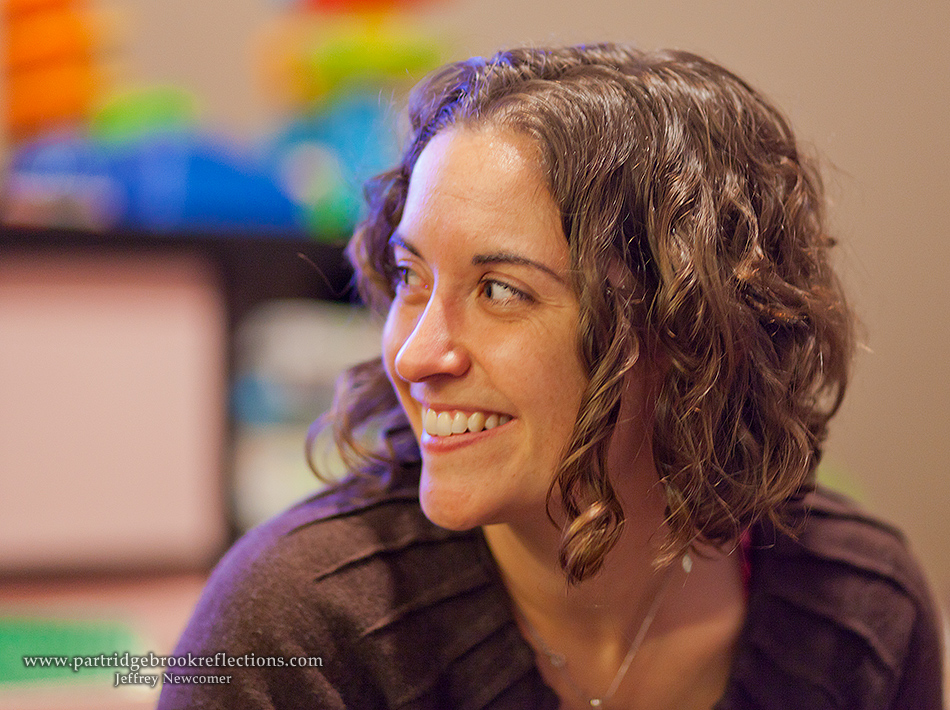
 I did admirably for the first half of the afternoon, but I became increasingly aware that I was surrounded by numerous attractive, neatly dressed models. The kids were irresistibly cute, Abigail was gorgeous, and my son found himself in a social environment which
made him less inclined to give me the finger whenever I
tried to take his picture. I couldn't resist.  I grabbed my 85 mm f 1.8
Aunt Deborah
portrait lens, cranked up the ISO and began
trying to record incessantly moving children in low light. Shooting at ISOs ranging from 1600-6400 I still needed to use all the light gathering capabilities of my fast lens. The young kids were probably less camera shy than my adult children, but they had absolutely no conception of what posing for a shot entails. Since the worst expressions always followed instructions to "smile", all I could do was follow them around and try to anticipate fleeting moments of spontaneous joy. My own children have learned over years of painful experience that I will not get out of their faces until they give me a reasonable shot.   Happily, I discovered that, after dinner, as the Tryptophan induced coma settled in, everyone became much more open to my efforts.

Approaching Coma


Stephanie
The biggest challenge of photography in low light without flash is controlling the paper thin depth of field. Shooting wide open creates beautiful soft Bokeh, but it is a constant struggle to keep the focus point on eyes, where it belongs. This becomes almost impossible when photographing fidgety little children. You often have to shoot bursts and hope that their eyes will randomly wander into focus in at least one of the images. Often when trying to photograph two or more people together 
Melissa
your only option is to decide whose eyes are most important to the image 
 and let the others drift off.  Despite the difficulties, it is almost magic that a largely fuzzy image can seem sharp as long as the eyes are in focus..   As a landscape photographer my goal is usually to get the maximum depth of field, but in these situations I just have to let it go. It is remarkable how much selective focus can add clarity and impact to the right subjects.


Stephanie Blurry Eyed Uncropped

Despite my complaining I couldn't wait to get home to start working on these images.  In general there was little manipulation required. Camera RAW did a nice job suppressing the high ISO noise. A quick tungsten adjustment got me close to natural looking color balance. I removed a few zits and softened the occasional harsh shadows. I spotlighted the key subjects, cropped and I was done. One interesting challenge came with an adorable picture of 3 year old Stephanie sitting pensively on her grandmother's lap. I only caught one good expression and in that image it was her 
Stephanie's Mouth
mouth rather than the eyes that was in focus. It was too cute to throw away, so I decided to go with the mouth. I cropped to skewer her mouth on one of the "Rule of Thirds" points and put my spotlight on the same location. The difference is subtle and the eyes are still a blur, but overall I think the image has much better flow.   Hopefully viewers will think I shot intentionally to draw attention to Steph's expressive mouth.


With each opportunity to shoot events I find that I increasingly zoom in on the faces. I have to stop this before my fascination with candid portraiture entirely replaces my long term commitment to rocks and trees.

Monday, November 21, 2011

The Power of Coming Back

All images from Roads End Farm in Chesterfield, New Hampshire


One of the exciting things about photography is that there are always new territory to explore. I love the opportunity to discover fresh locations and have found that touring with a camera in hand is the best way to fully appreciate the novelty of travel. It is not by accident that the most interesting and beautiful places to visit are also the best to photograph. The challenge of travel to distant locations is that the window of opportunity to catch interesting light is usually quite limited. I can't afford to return to Zion or Lake Louise 10 or 15 times to capture the perfect sunrise, but I can come back to my local sites as often as necessary to capture the magic and that is the power of coming back.


This weekend I went shooting at my favorite local farm and was freshly reminded of the power of coming back. Roads End is a unique horse farm just down the road in Chesterfield New Hampshire. During the summer it is a bustling girls riding camp, but throughout the year it is home to over 60 horses (and one fat cat) all in a varied and beautiful natural setting.  Tom Woodman has struggled in these hard economic times to keep the family farm running and his success has preserved 360 acres of lovely pastures and forest. I return to Roads End at least every week to look for new photographic opportunities. It is an unbreakable tradition for Nellie and I to visit after going to the dump every Saturday morning. The remarkable thing is that on almost every occasion, over the last 8-9 years, I have
found something new and interesting.  After all I live in New England; the weather and light is always changing and with over 60 horses as subjects I have yet to find a limit to the varying compositions of fields and fauna. Roads End also features a number of gorgeous pastures and glades which change in light and mood with each season.


I have my habitual favorites, but for some time, I had noticed an interesting, unexplored open glade just across from one of the larger pastures. The glade offered a tempting chance to shoot the horses in among the trees especially in the morning when the warm light knifes through the pines. I had never
ventured there in the past in part because it would involve wading through dozens of unfettered horses, some with serious
dominance issues, and also because it required slogging through yards of ankle deep mud. This weekend, however, I came with the right boots. I left the disappointed dog at home to avoid spooking the animals and made my way across the field. Early in the morning the horses were all anticipating the hay wagon. Their interest in me centered primarily on discovering whether my camera bag contained any hay or apples. The trick was to hang around long enough for the curious to stop nosing my bag and for the more timid to accept that I was not a threat. Once the horses resumed acting like horses the glade became a quiet magical place to experience and shoot. The light wasn't the best, but it was a good day to explore a new part of the farm. I will come back when the light is softer through the mist. After years, it is remarkable that I am STILL finding new opportunities I have learned the power of coming back.


As invigorating as travel can be to our photographic eye, don't neglect the special benefits of staying home. Become intimately familiar with the best of your local attractions. Learn the optimal seasons, light and angles for each location. I have several favorite farms in my region; each has it's own attractions, but even more importantly I have come to value the local farmers as friends and protectors of our region's fragile beauty.  I frequently share my images with them and they are invaluable sources of information and perspective. A good relation with landowners and farmers can open up a wealth of special opportunities for photography. It is all part of the power.


Check out my Roads End Farm Set on Flickr for more images

The Farm's Web Site is at : http://www.roadsendfarm.com/

Monday, November 14, 2011

Lessons from the Stream


"Snowliage" Canon 5D 16-35mm Lens

Canon G11
I am happy to report that I am now photographically whole after several weeks with my beloved Canon 5D Mark II and the workhorse 24-105 lens away at the Canon Service Center in New Jersey.  My friend and talented newspaper photographer Steve Hooper reassured me that accidents are bound to happen as a necessary price of getting out there for the shot, but I do seem to have a pathological tendency to regularly dunk my equipment in the beautiful streams and lakes of New England. This time I relearned the important rule that one should NEVER leave your tripod unattended. I swear I turned my back for a split second to adjust a branch and the tripod maliciously tipped my camera into the stream. The camera was only partially doused for a second, but it was enough to freeze the shutter button and for water to get on the front element of the lens.   


After it became evident that no amount of drying would restore reliable function, I sent the camera and lens off to New Jersey. The service center did a prompt and professional job. I got the camera back in about two weeks in "factory condition" which means that, in addition to the repairs, the camera and lens were cleaned and calibrated. It was of some consolation to discover that my first images had absolutely no dust on the sensor. That won't last.


Canon G11
The whole process provided an expensive lesson in the importance

of scrupulous care of the equipment. The fact that this disaster struck at the best moment of this year's fall foliage only magnified the impact. The late October snow spotlighted the previously dull color and provided a spectacular conclusion to the season that I was afraid I would miss in my crippled state. If there was one positive aspect of the experience, it was the fact that I was evicted from my usual comfort zone and forced to use back-up equipment. The great lesson turned out to be that it is refreshing to work within different restraints imposed by more limited resources and to be reminded that it is the light and not the equipment that is always most important. Of course I was not terribly impoverished when it came to equipment options. I didn't have to dig out my old Kodak Instamatic. 

Harvey Pond, Westmoreland, NH
Canon 5D, 16-35 mmm
My back-up Canon 5D is an incredibly capable camera that I have been recently using only for time-lapse.  Not a bad fall-back option, but with the loss of my 24-105mm lens, I had a large gap in my focal length range.  Everything from 35mm to 100mm was a dead zone.  The happy result was that I becaming more comfortable seeing through the perspective of my 16-35mm wide angle lens. Too often I get lazy about changing lenses and routinely accept 24mm as my widest view. It is always surprising what a big difference just a few millimeter can make in the structure of an wide angle image. At the other extreme of focal length, I had no trouble when I could use the reach of my 100-400mm telephoto lens to capture scenes such as the horses in the pastures of Roads End Farm. It turned out to be a creative jolt to be forced to visualize scenes only from the extremes of focal length, but I did have another option

Roads End Farm Pasture
Canon 5D, 400mm


Canon G11
.For more complete coverage, my other camera choice was my Canon G11. I got this camera as a relatively small "carry around" that I could keep with me whenever I didn't want to lug my trailer load of equipment.  The G11 is a surprisingly versatile camera with a full range of manual controls and raw capability. The image quality is also excellent especially in good light. During the last few weeks I have become more comfortable with the camera's occasionally confusing menus and buttons and found it liberating to have all that power in such a small package nestled in my hand. The G11 does not have the fine focus control, resolution, or low light capability of the Mark II, but I was surprised to find myself a little disappointed when I finally gave up the camera's easy portability for my massive, neck straining DSLR.

 
Multi image depth of field with the Canon G11


Canon G11
So the end result of giving my camera a chilly autumn bath was first that, thankfully, I was able to get my primary camera back freshly cleaned and fully functional.  I was also forced to approach photographic opportunities in fresh ways and the experience was eye opening.   I would not recommend drowning your camera to achieve these in-sights. Instead you might try going out on a shoot with self imposed, not disaster related, restrictions. Use only your wide angle lens or use a smaller camera in situations where your clumsy DSLR may be encumbering. You will be surprised how quickly you start seeing and working in creatively different ways.

Of course I am thrilled to have my camera back, but I should mention one final lesson from this episode. It was in fact a good thing that I bought camera insurance!


Sunday, November 6, 2011

How Many Calendars Do You Want This Year?


I am excited to announce that my 2012 New England Reflections Calendar is out and at a store near you, I hope. It takes many hours to select the images and design the calendar, but the major effort always comes afterwards when I have to market it to the community. This is the time of year when my fall shooting is interrupted by frantic visits to local bookstores, card shops, galleries and any place else I can think of to get the calendar out for the brief prime sales period from now until New Years. This is also the time of year when my friends start looking the other way when I walk by, knowing that any eye contact will be immediately followed by, "So how many calendars do you want to buy this year". I am normally quite reluctant to push my work, but the fact that all the money goes to the Cheshire Medical Center Pulmonary Rehabilitation Program gives me license to be as obnoxious in my hard sell as possible.


The Pulmonary Rehab program has always been very special for me and not just because I have been the medical director since its creation. The treatment of chronic lung diseases such as emphysema, chronic bronchitis and pulmonary fibrosis is frequently complex
2006 Better Breathers

 and challenging for both patients and those who care for them. Cheshire Medical Center/Dartmouth-Hitchcock Keene provides a comprehensive outpatient Pulmonary Rehabilitation Program to serve the needs of patients in our community. Our goal for those who struggle with these difficult diseases is to improve their understanding, comfort and functionality. Over several years the sale of the New England Reflections Calendar has raise over $40 thousand dollars to supplement the program and assist patients who need help covering the cost.


Brattleboro Vermont
The process of selecting the images and putting the calendar together every year is exciting, but challenging . It is still surprising to me that stores start selling next year's calendar in the middle of summer and I have never been good about getting the calendar completed early enough. I'm lucky if I get mine out by early fall. As each year goes by I find myself increasingly looking for the illusive perfect "calendar shots". In addition to being great images calendar shots need to tell an interesting story that I can relate in a couple of coherent sentences in the caption. It is always helpful if I
Sugar Hill, New Hampshire
can remember where I took the picture. Generally my photographic eye gravitates toward vertical images. I suspect this vertical preference comes from my attraction to a wide depth of field, but, given the calendar's format, my pictures must be in landscape orientation. As the calendar deadline approaches, I have a growing stimulus to rotate the camera looking for the horizontal perspectives. I have learned that, regardless of what appears to be the strongest composition, it is a valuable to routinely try to get both horizontal and vertical versions of attractive scenes.  You never can predict what a future client may prefer. In general the calendar images focus on my corner of New England. I know my audience. 
"Spofford" the Moose
I try to get a fair share of pictures from both the Monadnock Region and southern Vermont, and, of course, any picture which features Mt. Monadnock will sell. Typically I will also include one seacoast image and one wildlife portrait, but this year, with images of Seagulls, Blue Herons and "Spofford" the Moose, the animals rule. In the end the toughest part about image selection is all the pictures you have to leave out, but , happily, there is always next year. 


You can check out all the images in this year's calendar in the 2012 New England Reflections Flickr set.


So now for the shameless plug.
If you would like to purchase a spectacularly beautiful 2012 calendar and also support a wonderful cause, I would be happy to oblige. They are only $15 and make wonderful, and inexpensive holiday gifts. Send me an email or give me a call. If you are nearby, you can pick up calendars at many fine local stores, including (so far):

The Cheshire Medical Center Gift Shop, Keene, New Hampshire
Toadstool Bookstore, Keene, New Hampshire
Pocket Full of Rye, Keene, New Hampshire
Heidi's Hallmark, Keene, New Hampshire
Hannah Grimes, Keene, New Hampshire
Ingenuity Country Store, Keene, New Hampshire
Monadnock Imaging, Keene, New Hampshire
JJ Discount Store, Spofford, New Hampshire
Harrisville General Store, Harrisville, New Hampshire
Westmoreland General Store, Westmoreland, New Hampshire
Jingles Christmas Shop, Westmoreland, New Hampshire
East Hill Farm, Troy, New Hampshire, New Hampshire
Gilsum Village Store, Gilsum, New Hampshire
Vermont Artisans Designs, Brattleboro Vermont

So if in the next several weeks we should see each other on the street, just be warned, you WILL be asked "How many calendars would you like this year"


Click Here, for more information about the Cheshire Medical Center / Dartmouth-Hitchcock Keene Pulmonary Rehabilitation Program.