Sunday, November 11, 2012

Photographing the Magic of Velvet Water

Doanes Falls Royalston, Mass. 5 Seconds

 The leaves are gone and we are thoroughly trapped in the November Stick season. For New England photographers this
Senter Falls, Lyndeborough, NH, 1.3 Seconds
mostly means waiting anxiously for the first snows to to cover up and decorate the scars of another brilliant autumn. While we wait, the photographic opportunities can seem limited, but not totally absent. If you are fortunate to live near the coast, the recent late autumn storms, provided spectacular crashing waves. The fallen leaves and bare branches always produce some interesting patterns and whatever the subject, the late sunrises make catching the warm morning light much more civilized. Perhaps the best late autumn opportunities come from the falling water. Stick season can be a great time to capture waterfalls. Late autumn rains seem to bounce off the hardening earth directly into the streams and brooks, quickly engorging our waterfalls. Falls which are screened by summer foliage become more visible with the leaves on the ground and those colorful leaves often make a lovely border for the tumbling water. 


My wife Susan is not a waterfall fan. When I show her a picture of a spectacular cascade with the water rendered, by long exposure, to a fairyland of tumbling, velvety folds, her reaction is always, "Yup, another waterfall". I am not discourage, but the question is, how to capture the experience of such a relentlessly kinetic phenomena into a static image. Short exposures can freeze interesting patterns in the tumbling water, but I love the soft mysterious waves that are revealed with longer exposures.


Beaver Brook Falls, Colebrook, New Hampshire

So what are the essentials of capturing waterfall magic.

Being There


Arethusa Falls, 1/20 Second
As always the right weather is critical. Overcast or rainy weather is often best. Bright sunlight produces brilliant reflections and hot spots that can make exposure impossible without heavy application of HDR techniques. Soft diffuse light allows all of the detail in the rocks and water to shine through and lower illumination makes it much easier to use long exposures. In brilliant sunshine, even your smallest aperture and slowest ISO will not be enough to adequately slow the shutter speed. My bright sunlight image of Arethusa Falls in Livermore, New Hampshire required a polarizer and heavy application of my variable neutral density filter to soften the cascades.


Get Steady

It seems silly to have to say this, but waterfall photography requires a sturdy tripod. My only advice about tripods is spend the money to get a good one. If you buy a cheap tripod, you will be replacing it every few years and all you will ever have is a CHEAP tripod. An expensive tripod will be the only one you will ever need. It will save money in the long run and you will always have a GREAT tripod.

Filters

The essential photographic filter is the polarizer, and this is
Gleason Falls Bridge, Hillsborough, NH,  1 Second
especially true for waterfall photography. The polarizer performs the magic of blunting reflection on rocks and water allowing the native colors to shine through, but the maximum effect is not always the best. Some reflection may be helpful to add definition to the flowing water. Experimentation is the best way to find the right amount, but at times the optimal polarization for the rocks may be too much for the water. Here is we're the fun of stacked images and masking can come in, but, seriously, you can drive yourself crazy with this stuff. Most of the time a comfortable compromise is available. Finally the polarizer blocks one or two stops of light making it easier to capture the  long exposure required to "velvetize" (my word, feel free to steal it) the water.

"Proper" Shutter Speed

I have often struggled to find a simple rule governing the correct exposure for flowing water and it was a desire to resolve this issue
Forty Foot Falls, Surry, NH, 1.3 Seconds
that triggered the preparation for this article.  I tried to apply some scientific rigor to the problem. Last week I spent a couple of hours at one of my favorite local collection of falls and cascades, Forty Foot Falls, along Merriman Brook in Surry New Hampshire. These falls, include drops of varying heights and can be easily approached from different distances. I took multiple images from various locations with shutter speeds in increments from 1/30th  to 4 seconds. The weather was perfect, a dark overcast shortly following a significant rain storm. After careful analysis, the results of this non- randomized, single blinded study were conclusive and a failure.  


Garwin Falls, Wilton, NH, 1.3 Seconds
The best shutter for any waterfall is dependant on too many factors
to surrender to a simple formula.  The most important confounding factor, of course, is individual taste.  We all have our own preferences for the degree of "velvetization".  My overall goal for waterfalls is a shutter speed which is long enough to provide the velvety look without being so long as to render the water without any texture and interest.  On average I find this to range between 0.25 and 1 second, but the best result is dependent on a number of factors, including the speed of the water, the depth, interruptions to flow and the distance from the falls.


The Speed of the flow depends on the height and steepness of the
Chesterfield, NH,  0.6 Seconds is Too Slow
falls and the degree to which the water
falls unobstructed.  Faster flows are best captured with faster shutter speeds to preserve a sense of texture. 

Deep falls obscure the underlining rocks and depend on the water detail for visual interest making faster shutter speeds necessary. Here the water was fast and deep making 0.6 seconds too slow to record the water detail.

Obstructions such as rocks and ledges slow the flow, diverting and fanning the water into streams that can be captured at longer shutters before detail is lost. 


Forty Foot FallsTest
One of my series of images from a small segment of Forty Foot Falls illustrates a number of these factors.  On the left the water is falling in a smoother sheet.  It is all a matter of taste, but I find that above 0.4 seconds the water begins to loose detail and is less interesting, but the velvet appearance remains pleasing up to 4 seconds on the right where the water is obstructed and fanned by the visible underlying ledge.


Moss Glenn Falls 10 Seconds


All of these effects are blunted by greater distance from the subject.  My more distant image from Moss Glen Falls in Granville, Vermont
 was taken with full polarization and a 10 second exposure, but from this distant the interest came from the streaming and fanning of the water and was not weaken by the loss of surface texture.


Agonizing over all of these technical factors can be helpful, but they can also distract from the central fact, that waterfalls are actually pretty!  So, use them to get a rough feeling for the shutter and then judge your results by zooming into the LCD to make necessary adjustments.  When the LCD view is not enough, a little shutter bracketing can provide a little Velvet insurance in the digital darkroom.

Waterfalls remain one of my favorite natural subjects.  Following a few simple guideline can assure spectacular results.  With any luck, applying what I have learned, I may, someday, move Susan from "Yup, another waterfall" to her highest level of artistic enthusiasm, "Nice".


Sunday, November 4, 2012

Praise for the Under-Appreciated Beech


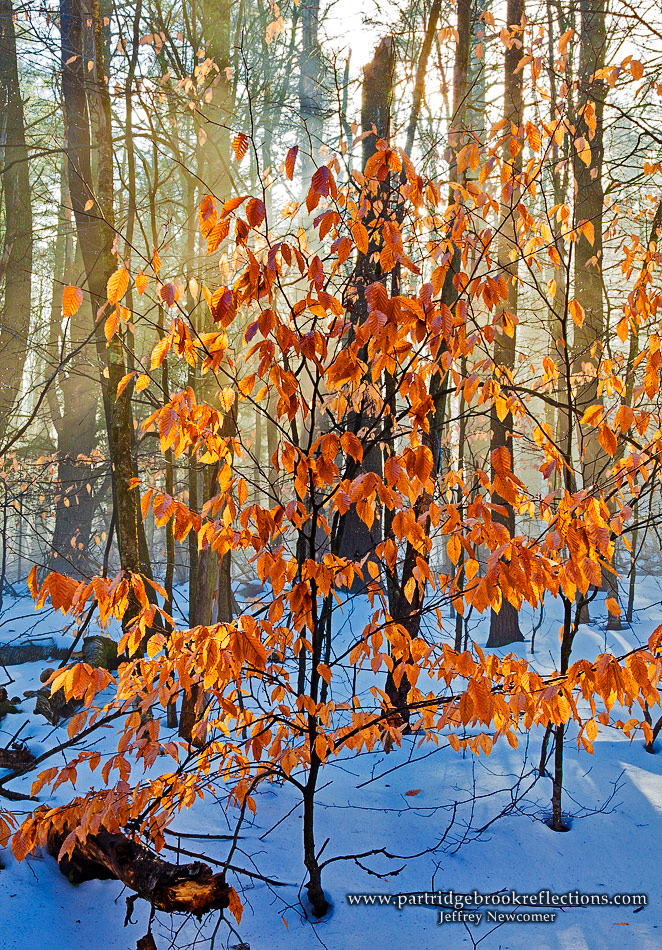
The Beech Take Command of Late Autumn, Chesterfield, New Hampshire
Persistence Counts

A few valiant Maples hang on
Ask most any fall foliage tourist and they will tell you that they have come to see
 the color, but in their minds eye they are seeing the Maples. Sure the early yellow
 of the birches and the later brown of the oaks can be lovely, but when it comes time to identify the iconic leaf of the season it is almost always the red and gold of our Maples. Who can argue, Maple trees in full display are spectacular, but they are also short lived and fragile. You have to be there at just the right time to catch the full show and the window of opportunity in any one place may last only a few days. As someone who is in it for the entire season, I would like to honor the tree which, although not the most spectacular, does more to extend the beauty of autumn in New England, the under-appreciated American Beech.
 

The Noble Beech

The American Beech is a native of the Eastern and Central United
Controversial Daniel Boone Carving.
I see 1776.
States extending from Florida to Nova Scotia. It is slow growing and can live for 300-500 years. The Beech is known for its smooth silvery bark which has for centuries provided a popular surface for name carvers seeking love or immortality. A Beech in Tennessee, dated at more than 500, years old, is thought by some historians
Beech Yellow and Brown
  to preserve a 1760 inscription by Daniel Boone. But this tree's value is much more than merely literary. Although Beech is difficult to split, its dense wood makes efficient burning fire wood. Beechnuts are an important source of food for many forest animals and it's trunk and branches provide homes for many creatures. Beyond all its other values, from a photographic perspective, the beech's greatest attribute is its persistence.


Hanging in There

Oak Leaves Hang on warmed by the Connecticut River
For me the American Beech is most notable for its ability to extend the foliage season. Its bright yellow leaves change late in the season and corageously cling to the branches well into the winter. 
Over time the leaves mature to a rich brown, but when the Maple leaves are largely on the ground, the Beech are just reaching their peak. There are other, late turning trees. Most notably, the Oaks are important contributors to late fall's evolution to earthy brown color, but they don't hang on like the Beech. 


Last weekend I was exploring the forest on the hills above Stonewall Farm and found myself surrounded by surprisingly brilliant yellow foliage, a few oak, but mostly the persistent Beech. It was an amazing display. I felt like I was transported back to peak foliage. In the winter, the Beech often provides a surprising splash of color decorating an otherwise black and white world.


Winter Color
Beech and Birch


So, as Autumn fades away, take a moment to honor the under-appreciated Beech. Without it, our fleeting New England Autumn would be just a little more fleeting and that is something we can do without.
As the winter progresses the Beech leave become thin and pale,
But STILL hang on!


Sunday, October 28, 2012

Photographing all of the New England Autumn


Keene Pumpkin Festival 2012, Disappearing Crowd, Long Exposure

 Don't Let the Leaves Get in the Way

Beginning in mid September through the early portions of November the New England climate goes through its most rapid transformation. It is our brief Mardi Gras before the long dark Lent of winter hibernation. The air becomes cool and crisp with cold nights often contrasting with surprising warm and sunny days still clinging to summer. The whole effect is to make us more aware and appreciative of our changing environment. New Englanders get
Forest Harvest
uncomfortable if the weather stays perfect for too long. It is the contrasts that keep us bright and energized. We are always excited about the first chilly nights that gives us an excuse to fire up the wood stove in the kitchen. For photographers, autumn in New England is a time of breathless pursuit of the spectacular colors that burn across our hills and valleys. It all goes so quickly that I find myself feeling guilty if I miss a moment of the amazing show, but the New England Autumn is about much more than the crazy brilliance of our trees. Visitors and natives alike miss most of the best features of the New England autumn by focusing only on the foliage. The season is also defined by the activities that are unique to our harvest time, the sounds and smells as well as the sites of this dramatic, fleeting time of climatic transition. Most of all, the fall is a time to enjoy the people of New England. We are often a quiet, guarded lot, but something about the nip in the air, and the impending winter, can bring out personal interactions that are, almost, cordial.

As photographers, it is our challenge to somehow capture all of this remarkable season into our visual medium. Let me suggest a few places to look for the a broader sense of the New England Autumn. 


Take a Hike

New Trail from Chesterfield to Keene, NH
First get out of your car and experience the trees on a personal level. You can even hung a Sugar Maple, if no one is looking. As the morning frosts sweep the pesky summer insects from the air, hikes in the forest become much more relaxed and enjoyable. It is the best time of the year to explore and photograph our trails. From within the forest the photographic perspective is much more about individual trees or small clusters, a viewpoint that I find much more interesting than when the color is smeared across broad hillsides. Also, the leaf covered trails provide strong compositional elements to draw the eye into the scenes. It is easy to find trail information and maps on the Internet or you can ask for suggestions at the ubiquitous local General Stores. If you are in my town of Chesterfield, New Hampshire, you can come to our Conservation Commission web site to the discover the mile of trails that we struggle to maintain. When you have finished your hike you will be ready for the next attraction, food. 


 Eat

Petes Stand, Walpole, NH
Autumn is also harvest time in New England and the many festivals, farmer's markets and road-side farm stands provide great photographic opportunities as well as wonderful produce. I often take advantage of overcast days to capture the varied colors and patterns found in the markets of our area. Soft diffused illumination allows the colors of the fruits and vegetables to shine through, without being washed away by bright reflected light. I look for interesting arrangements of produce to place in the foreground while guarding against distracting background elements. My fast macro lens is especially helpful to keep the background muted in a soft bokeh, while focusing in on the interesting detail. The attraction of farmer's markets is as much about the people as the produce. These folks are justifiably proud of what they have drawn from the earth and it shows in their faces. Some of my favorite market photographs are those that highlight the character and strength of local farmers. 


Maple Death
Nila's Pride

Dozens of Chutney Flavors


Harvest Festivals

Morning Glow, No People!
Of all the regional harvest festivals, none can compare to the Annual Pumpkin Festival in Keene, New Hampshire. The attraction of the Festival is not just the incredible number of lit pumpkins (29,381 last weekend), but it is all those Pumpkins in a perfectly classic New England setting. The combination makes our festival a uniquely wonderful
 harvest celebration. The crowds can be daunting, but there is nothing to compare with an entire New England Main Street smelling like Pumpkin Pie. To avoid the mobs I always go downtown early in
Scaffold at Dusk
 the morning. There is almost no one there between seven and eight AM and, although the candles are not lit, the Pumpkins are often illuminated by the warm morning sun. The best time to capture the massive
Central Square Pumpkin Scaffold is at dusk when there is still a hint of light to provide a deep blue background to the complimentary orange and gold. The trick is to avoid the crowd by getting your camera as high as it will go on the tripod, while monitoring the distracted multitude as they attempt to stumble over the tripod legs. The scaffold is impressive, but don't miss shots of individual Pumpkins or small groups. Given the mass of people in the evening, you could wait for hours to get a clear shot at an attractive composition, but the crowd can be reduced by taking long exposures making passersby magically disappear. 


As October draws to a close and the last leaves surrender to the inevitable, we photographers get to extend the season as we work our way through the piles of autumn images waiting to be processed. The color was good this year, but I find that it is the other attractions of harvest time in New England, the soft light, the rich smells and the wonderful people, that linger to warm the long dark winter.

Sunday, October 21, 2012

A Calendar for a Great Cause


 2013 New England Reflections Calendar


August Persistence
It is time for my annual, unashamedly promotional blog, but it is for a great cause. My 2013 New England Reflections Calendar is now out and I am in full marketing and distribution mode. I have already delivered to many of my best venues, but have many more to hit. As is true every year, I am convinced that this year's calendar is the best ever ( check out the images at my Calendar Flickr Site), but I have learned that it's success depends more on my ability to get the calendar into the public eye than it does on the beauty of the photography. Over the years I have learned that the best locations are those in which the customer is likely to be thinking of calendars. Book stores and gift shops work much better than general stores and my auto repair shop, but all contribute to sales and I am grateful to everyone who welcomes the calendar.


Storm's Last Light
Spofford, NH
As always, all of the profits from the calendar go to assist the work of Cheshire Medical Center's Pulmonary Rehabilitation Program. Pulmonary rehabilitation provides a multidisciplinary program combining education, exercise and support to patients with debilitating chronic lung diseases. I have been medical director of the program since its birth, but my job consists mostly of supporting our remarkable staff as they bring hope to patients who often fear that there is no more that can be done to improve their lives.


Reimbursement for rehabilitation has always been extremely thin and our program has survived on the edge for years. The funds from the New England Reflections Calendar have been an important supplement, providing assistance to patients who can't afford the program and has also provided support for important extras such as the yearly Lung Cruise on Lake Winnipesaukee.
Back Road Gold, Chester, Vermont (October)
  
As the fall foliage continues to race away to the south, you can expect to see me wandering the streets hawking my calendar. Take pity and buy one, or a few. They make great gifts for a great cause and besides, it is a pretty calendar!
Against the Dawn, Portland Head Light (September)
The New England Reflections Calendar is available in lovely stores throughout my region. You can also safely order the calendar online from Cheshire Medical Center.
And we will cover the shipping.
The price again this year is only $15.


Thanks to all of the wonderful stores who are featuring the Calendar including:

  • Cheshire Medical Center Gift Shop, Keene, NH
  • Pocket Full of Rye, Keene, NH
  • Hannah Grimes, Keene, NH
  • Heidi's Hallmark , Keene, NH, (also Milford and Rindge)
  • Ingenuity Country Store, Keene, NH
  • Harrisville General Store
  • Monadnock Imaging, Keene, NH
  • Leon's Auto Center, Keene, NH
  • Westmoreland General Store, Westmoreland, NH
  • Jingles Christmas Shop, Westmoreland, NH
  • J & J Discount Store, Chesterfield, NH
  • Vermont Artisan Design, Brattleboro, Vt
  • Sharon Arts Center, Peterborough, NH

Check out this year's images on my Calendar Flickr Set.


Sunday, October 14, 2012

Steadying Your Low Light Photography


Old Stone Arch Bridge, Stoddard, NH
Hand-Held,  ISO 400,  1/15th Second Exposure
  
Getting the Jitter Out of Hand-Holding
A couple of weeks ago I was out on a dark overcast afternoon looking for fall foliage scenes and tragically discovered that I had left my tripod in my wife's car.  I managed to salvage a few pleasant images of the Old Stone Arch Bridge in Stoddard New Hampshire, but I couldn't get all I wanted out of the nicely flowing water.  The situation impressed on me the importance of remembering my damn tripod but also of the value of good hand-held photographic technique. In my misspent youth, I had pride in my ability to steadily hand-hold my camera for exposures as long as 1/10th of a second without loosing sharpness. With advancing age and perhaps a heightened standard of sharpness, I realize that such feats are no longer possible. Thankfully the introduction of image stabilization and the practical availability of high ISO has kept hand-held low light photography literally within my grasp, but, even with these aids, it is important to reinforce the value of proper shooting technique to achieve the sharpest results.


Boston Skyline, Hand-Held
In a previous article I discussed approaches to low light photography without a tripod.  I focused on the use of aids for
stability such as trees and railings and the application of high ISO to allow shorter exposures. Regardless of the lighting conditions, however, adherence to a few simple rules can enhance the steadiness of your "photographic platform" and improve the sharpness of all of your images. It takes practice, but with persistence, good technique can become automatic, playing in your head like a photographic mantra before each shot. 


Stance
Stable Katie
Stability starts with the stance, legs comfortably apart, knees slightly bent. I usually place one leg slightly in front of the other. For added stability I kneel with my elbow resting on one knee. Lying prone on the ground can work even better and can provide some interesting new perspectives, but I don't want to get carried away with this sort of thing. Besides It was tough enough to get Katie to model the kneeling position. 


Camera Hold
 I hold the camera with one hand on the shutter and the other cradling the lens. This becomes increasingly important with longer and heavier lens' which awkwardly shift the center of balance. I pull my arms in, pressing my elbows against my chest,  to provide extra points of stability and just before pressing the shutter I draw the camera firmly against my face. Two elbows and  one face provide my own corporeal tripod.  I release my breath and hold it for the shutter release.


Shutter Release
No matter how stable my shooting platform, the act of pressing the

Susan's Lovely Finger Roll Technique
shutter introduces an opportunity for shake. Perhaps that is one reason that it is called the "shutter button", but there are a number of techniques that can reduce the jitter.  First, as a routine, I use the rolling shutter technique, rolling my finger over the button instead of pressing down. This may feel
awkward at first, but with practice, it can make a significant difference. I start by placing my index finger firmly just in front of, and barely touching, the button (see the illustration).  Then, while maintaining the pressure, I roll my finger over the shutter.  Give it a try.  The result is a much smoother release, without the jolt of a downward stab.  A couple of other tricks can help reduce the
2 Second Delay
shutter release jitter. I have mentioned before the use of the 2 second shutter delay on my Canon DSLR. The pause allows me time to stabilize the camera before the exposure. I also find it helpful to shoot in burst mode. Pressing and holding the shutter for several shots often produces at least one sharp image.


This is my approach to steady camera technique.  I would be
North Branch River, Stoddard,  NH
ISO 400, 1/5 Second, f18, Leaning on the Bridge


interested to learn any additional tricks you may have.  The secret is to develop a routine and stick with it.   I'm not always perfect in holding to these practices. I'm often distracted by the excitement of the scene and it can be difficult to adhere to a ritual when trying to seize the moment as a majestic raptor soars by.  But despite the difficulties, the combination of high ISO and aperture control to increase the shutter speed, and the careful use of  techniques to improve the stability of your photographic platform can greatly enhance your ability to shoot hand-held in low light situations.

Of course, alternatively, I could have simply remembered to bring the damn tripod!


Don't forget to check out my new Blog Index

Jeffrey Newcomer 

partridgebrookreflections.com

Sunday, October 7, 2012

Northeast Kingdom Fall Photography


Barnyard Maple Irasburg, Vermont
  
A Jump-Start on the Foliage and Some New Friends


The color is coming fast to my corner of central New England. It is clear that the autumn show will be much better than last year, but it also seems to be coming through like a freight train. Just over one week ago I was enjoying the near peak color in the Northeast Kingdom of Vermont and this weekend there are parts of my hometown Monadnock region and southern Vermont that are looking bit past prime. This time of year is always a breathless sprint, trying to get the most out of the New England's best visual moment, but this year it seems a bit more breathless than usual.
Given the frantic pace of this year's season, I am especially
Eden Lake, Eden, Vermont
glad that I got an early shot at the color, spending a lovely day exploring parts of the Northeast Kingdom with a group of new friends, all fellow members of the New England Photography Guild. The Guild is a group of 15 inspired photographers from throughout New England who focus on showing our region at its best. I was honored to be accepted to the group about one year ago and although I have enjoyed following the work of these talented folks, I had met only one. I stumbled into Jim Salge by accident in the predawn light of a Lupine field in Sugar Hill, New Hampshire. When I heard that several of the members were planning to meet in northern Vermont, I couldn't miss the opportunity to replace the static thumbnail head shots with actual animated faces.


Irasburg Barn, Irasburg, Vermont
Vermont's Northeast Kingdom is a collection of towns in the far Northeast corner of the state encompassing Essex, Orleans and Caledonia Counties. It is renowned for its classic New England beauty and atmosphere. In 2006, the National Geographic Society named the Northeast Kingdom as the most desirable place to visit in the country. I had been enchanted by the region during a summer visit a few years ago, and I was thrilled about to my first chance to sample the early autumn color.

Golden Swirl
The plan was for the group to meet early Friday morning in Eden, Vermont near the home of guild member Gustav W. Werderber. Gustav had agreed to be our guide to a number of his favorite spots. The "Kingdom" is about two and one half north of my home and, to be fresh, I drove up the night before, staying in a comfortable Bed and Breakfast in Lyndonville Vermont. I would show you a picture of the classically Victorian Moonlight Inn, but I arrived after dark and left before dawn. My greatest regret from the trip was that I missed the breakfast part of the B&B.


Needless to say there were the inevitable hassles of

Northeast Kingdom Sunrise, Barton, Vermont
assembling a group coming from throughout New England to a region known for its spotty cell phone reception. I had the advantage of starting close by and took the opportunity to catch some sunrise images. The day dawned overcast, but, on my way to Eden, the clouds broke just enough to project a few moments of golden light. I was late for the rendezvous, but I couldn't waste the light. As I drove, I was desperately looking for an interesting foreground to place in front of the dawn. A small farm pond finally filled my requirements nicely. The light remained warm and given all the wonderful farms and pastured hills, it is amazing that I made it to Eden at all.

Once assembled, our group of five had a great time


Kingdom Color
exploring a couple of Gustav's favorite water falls. I found much to learn from the vision and technique of these talented photographers. At each location, It was interesting to see how we all slipped , quietly, into our own zones of concentration on the task. When a group of photographers are faced with a beautiful subject, everyone gets very quiet, as they explore the scene. Like everyone else I am used to solo photography and I had to remind myself to look up to appreciate and learn from what others were doing.


Four Corners Falls, Troy Vermont
The weather was variable on this day. Partially sunny in the morning, progressing to clouds and drizzle in the afternoon. Each condition provided its own opportunities and challenges. At Four Corners Falls I used a graduated neutral density filter to tame the brutal contrast from bright sunlight to deep shadow. Later my essential piece of equipment was a towel to keep my gear protected from the penetrating rain. In all conditions, my circular polarizer was a essential tool, enriching the colors by blunting the reflection off the foliage.


Autumn Rain, Stowe Vermont

Our finally destination for the day was the lovely village of Peacham Vermont. I had been to Peacham only once before and never found the prime spot to capture the classic view of the village, with the white church and red barn. By the time we got there, it was dark and damp, but we did find the spot. Sadly some misguided non-photographer had replaced a large portion of the barn's rusted roof with a new horridly brilliant steel section. I could wait several years for the roof to weather, but I may be forgiven for doing a little weathering of my own.


THE Classic Peacham View


The Guild Team
L-R: John Vose, Jane Oglivie, Jeff Folger,
Gustav W. Werderber, and Jeff Newcomer


At the end of the day we were all happy, tired and damp. The day was full of great photography and a chance to get a heads start on autumn, but much more valuable was the chance to get to know a group of dedicated, talented photographers who share a commitment to celebrate the unique beauty of New England.


The New England Photography Guild Web Site and Blog
The New England Photography Guild Facebook Page

Check out my new 
Getting it Right in the Digital Camera Blog Index